
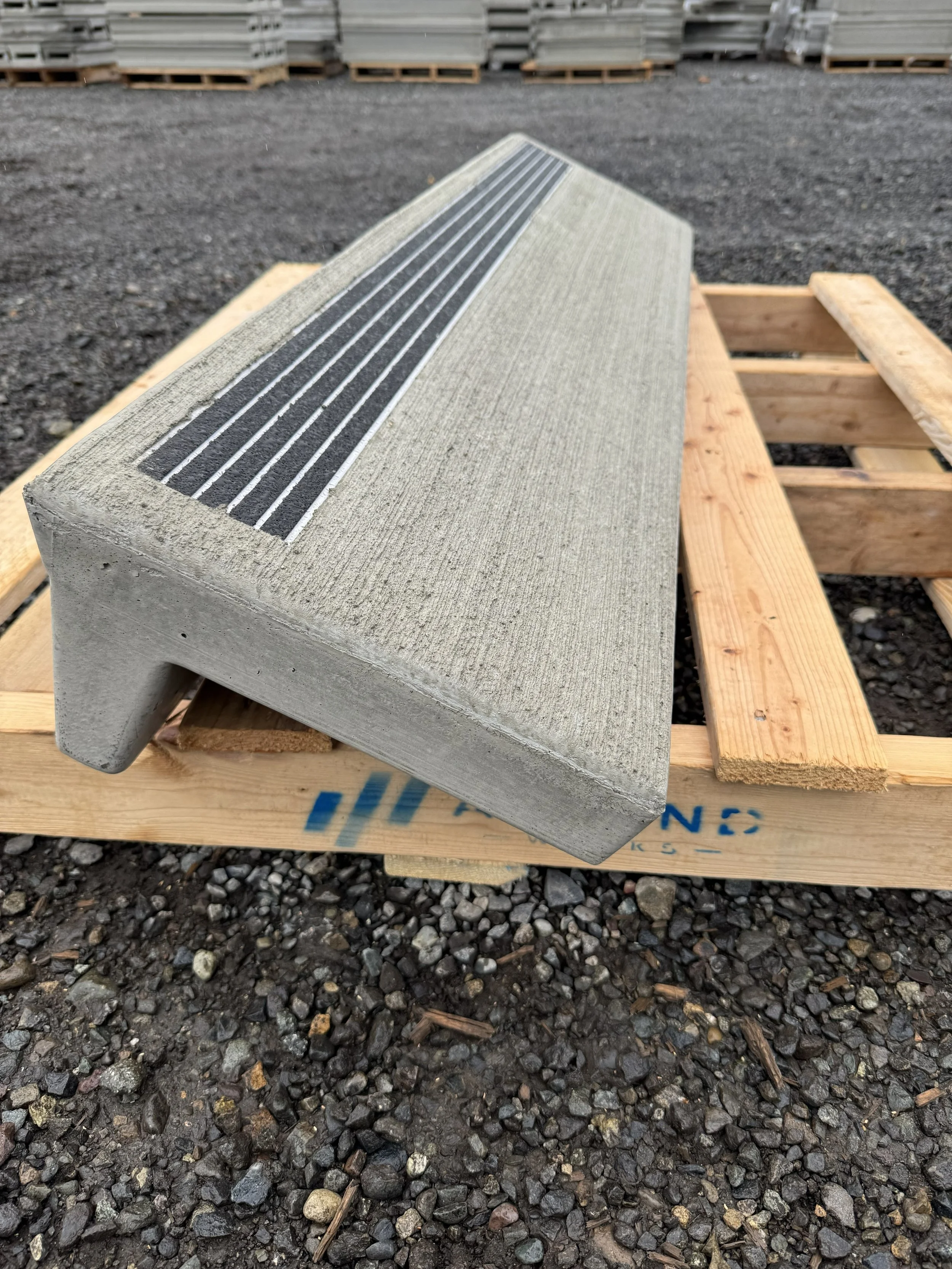
We ship stair treads to you for:
New Apartments & Renovations, commercial projects, tenant improvements, industrial projects and residential!
In all of these states and more!
Washington
Oregon
Idaho
Montana
Wyoming
Utah
Colorado
California
Arizona
New Mexico
Texas
Our superior partners and locally sourced components (cement, rebar and admixtures) provide an incredibly finished product!
WHY PRECAST CONCRETE STAIR TREADS vs SOMETHING ELSE, YOU ASK?!?
1. Superior Durability and Impact Resistance
Precast concrete withstands heavy foot traffic, furniture moving, appliances, and abuse common in apartment buildings.
Less susceptible to cracking, gouging, delamination, or surface damage from sharp impacts.
Typically maintains its structural integrity and appearance for decades with minimal maintenance.
2. Better Fire Performance
Concrete is inherently noncombustible.
Helps simplify compliance with IBC and multifamily fire-resistance requirements.
Does not contribute fuel or smoke in a fire event.
Composite products often require evaluation of flame spread and smoke development characteristics.
3. Improved Sound Attenuation
The mass of concrete reduces footfall noise and vibration transmission.
Reduces complaints from residents regarding stair noise.
Composite treads can have a "hollow" sound and may transmit more vibration unless additional acoustic treatments are incorporated.
4. Lower Life-Cycle Cost
While initial installation costs can vary, precast concrete often delivers a lower total cost of ownership.
Requires little maintenance beyond periodic cleaning.
No coatings, UV protection, or replacement of worn wear surfaces are typically required.
Longer service life means fewer replacement cycles.
5. Enhanced Slip Resistance
Integral abrasive nosings and textured finishes can provide long-lasting slip resistance.
Surface texture is not dependent on applied coatings that may wear off over time.
Maintains performance in wet conditions common in exterior stairways.
6. Greater Perception of Quality
Concrete stairs convey a more substantial, permanent, and premium appearance.
Many developers and property managers view precast concrete as consistent with Class A and market-rate multifamily construction.
Can improve resident perception of building quality and durability.
7. Better Resistance to Weather and UV Exposure
Performs well in exterior applications exposed to sun, rain, freezing temperatures, and deicing chemicals.
Does not experience UV degradation, fading, or resin aging concerns associated with some composite materials.
Particularly beneficial in climates with freeze-thaw cycles.
8. Structural Robustness
High load-carrying capacity and stiffness.
Minimal deflection under occupant loads.
Creates a solid walking surface that feels secure underfoot.
9. Reduced Maintenance and Liability Concerns
Less susceptible to loose connections, surface wear, or material degradation over time.
Stable walking surface can reduce trip-and-fall risks.
Property managers generally appreciate the minimal ongoing maintenance requirements.
10. Proven Performance in Multifamily Construction
Precast concrete stair systems have a long track record in garden-style apartments, podium projects, affordable housing, and student housing.
Widely accepted by owners, architects, contractors, and code officials.
Predictable long-term performance with well-established design standards.
Key Owner Benefits
When presenting to developers, owners, or architects, the strongest arguments are typically:
Longer service life
Noncombustible construction
Reduced resident noise complaints
Lower life-cycle maintenance costs
Premium appearance and resident perception
Better resistance to abuse from move-ins, move-outs, and daily traffic